Thinking local, caring global: citizen science for urban ecosystems — a brief look at the citizen science session at EUROGARD 10
Caren
Queiroz,
Nov. 20, 2025, 1:08 p.m.
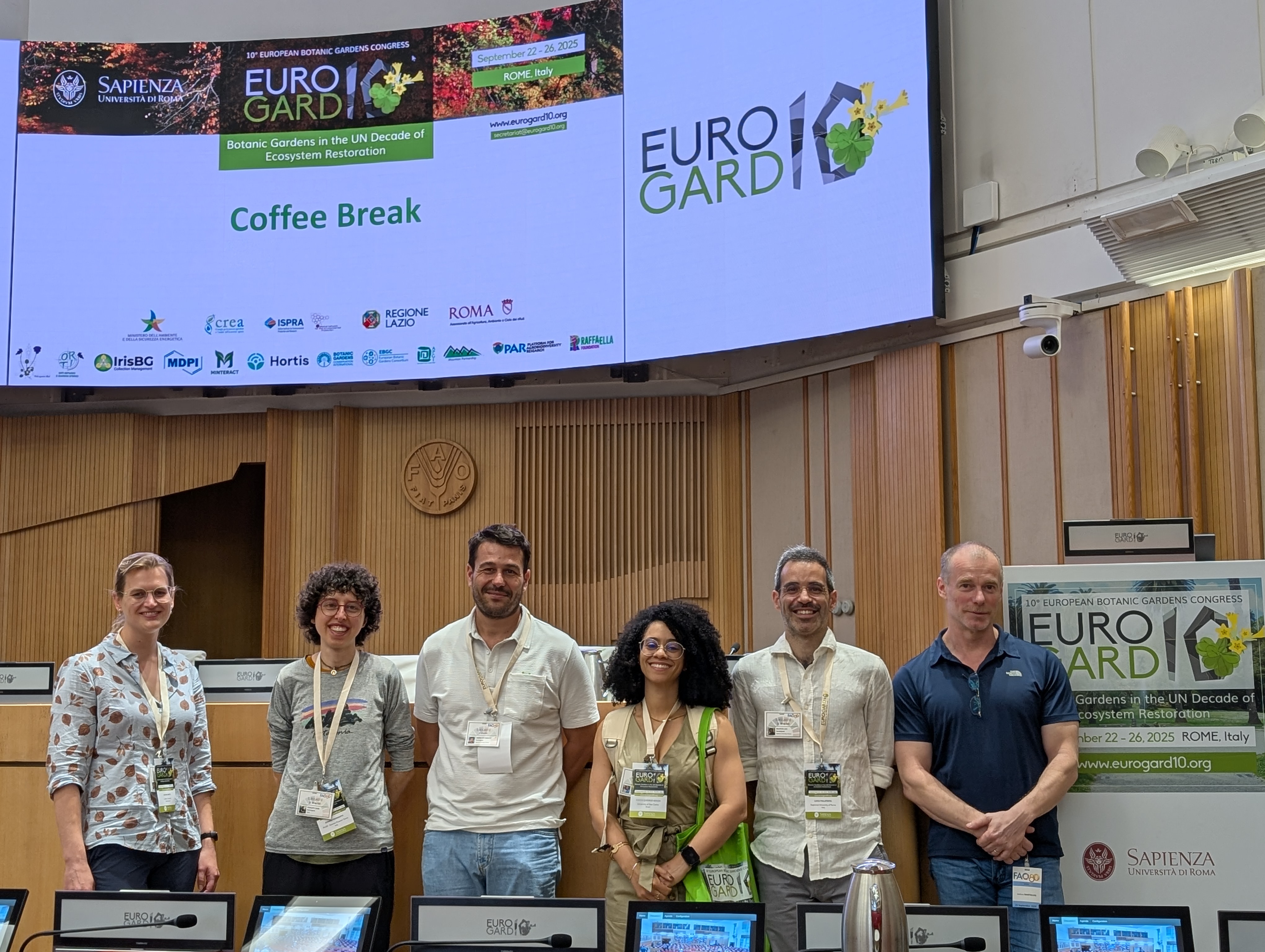
“Think locally, act globally”. This classic quote of the very missed Jane Goodall is more than an inspiration, but also a call to all involved in conservation. To do so, an acknowledged first step is to (re)connect people with nature. In urban environments, where most of the human population live nowadays, life seems to be faster, agitated and urgent. During the EUROGARD 10 (10° European Botanic Gardens Congress – Botanic Gardens in the UN Decade of Ecosystem Restoration), a session fully dedicated to citizen science in urban green spaces, co-organised by the European Citizen Science Association Green Spaces Working Group, showed inspiring examples of how to foster care for nature and promote scientific knowledge.
First, Dr Luca Malatesta presented his brilliant work entitled “A citizen science approach to urban biodiversity investigation and monitoring: the Atlas of the Flora of Aguzzano Regional Park in Rome”. He showed how citizen participation and scientific research can come together to protect and understand biodiversity. The Atlas of the Flora of Aguzzano Park was created with more than 3000 observations collected through iNaturalist and demonstrates the power of community-driven science. It was impressive to see how collaboration not only produced valuable ecological data but also strengthened public engagement with nature in the heart of Rome.

Figure 1: Orto Botanico di Roma. Photo Caren Queiroz-Souza
From Rome to Trento, Chiara Fedrigotti showed us the power of “Discovering alpine biodiversity through citizen science: a tiny collection of best practices from the Viote Alpine Botanical Garden”. The garden has become a living laboratory where visitors, students and scientists collaborate to study biodiversity. They build community, inspire curiosity, and transform visitors into active participants in conservation, blending research, education, and public engagement to deepen our understanding of alpine biodiversity and its potential to bring people and nature together. A little bit far from Italy, we moved to the Netherlands. The PhD student Nienke Beets showed part of her work entitled “Completeness and biases of large and small scope citizen science datasets of Dutch urban flora”. Her presentation approaches a crucial question in citizen science theory and practice: how the scope and structure of different projects affect the quality and usefulness of biodiversity data? She uses a simple and relevant method to address this question, comparing large platforms, like iNaturalist and Observation.org with smaller ones, such as the Dutch Stoepplantjes and Plant Alert. Her study explored how biases and data completeness vary across approaches. What made it particularly engaging was its practical relevance offering guidance for scientists and citizen science organisers on how to better use and design data collection efforts.
Particularly, in my own presentation entitled “Designing multi-taxa citizen science protocols to foster biodiversity monitoring and human–nature connection in urban green spaces”, I moved the audience even far away: to Brazil, specifically the countryside of São Paulo state. I showed the paths we followed in the BioFuturo na Cidade project to build a multi-taxa citizen science project focused on urban green areas and Botanic Gardens in four municipalities (Araras, Campina do Monte Alegre, São Carlos and Sorocaba). We follow three steps from theory to practice with academics and local communities to discuss protocols, tools, engagement strategies to monitor species and reconnect people and nature. Back to Europe, Katia Astafieff took us to France and presented her brilliant work on “Social inclusion and volunteering at the Botanical Gardens of Nancy, France”. She showed us that the Botanical Garden is an excellent example of how to foster social inclusion and community well-being. By reinventing its space, the garden is fostering connection and dialogue on hot topics like climate change and nutrition. For example, the workshops for underprivileged youth, aiming to make botany more accessible and meaningful for everyone, beautifully illustrate how a botanical garden can grow both plants and people.
From different world locations we could collectively discuss and reinforce how citizen science is powerful and transformative and potentially can bring together people and nature in urban environments with creativity and care. This session was a good opportunity for cross-fertilization among Green Spaces WG members, inspiring local actions with global impact.

If of interest the next session in Green Spaces WG takes place on 26th of November, register via the QR code.
Caren Queiroz-Souza, Postdoctoral researcher at Federal University of São Carlos